Guillermo Laporta Flutist · Composer · Director
Contact
← Software Case study Product design & build 2026

Polen

A grant tracker for an arts organisation that raises money in two currencies on two continents, and keeps missing deadlines nobody has published yet.

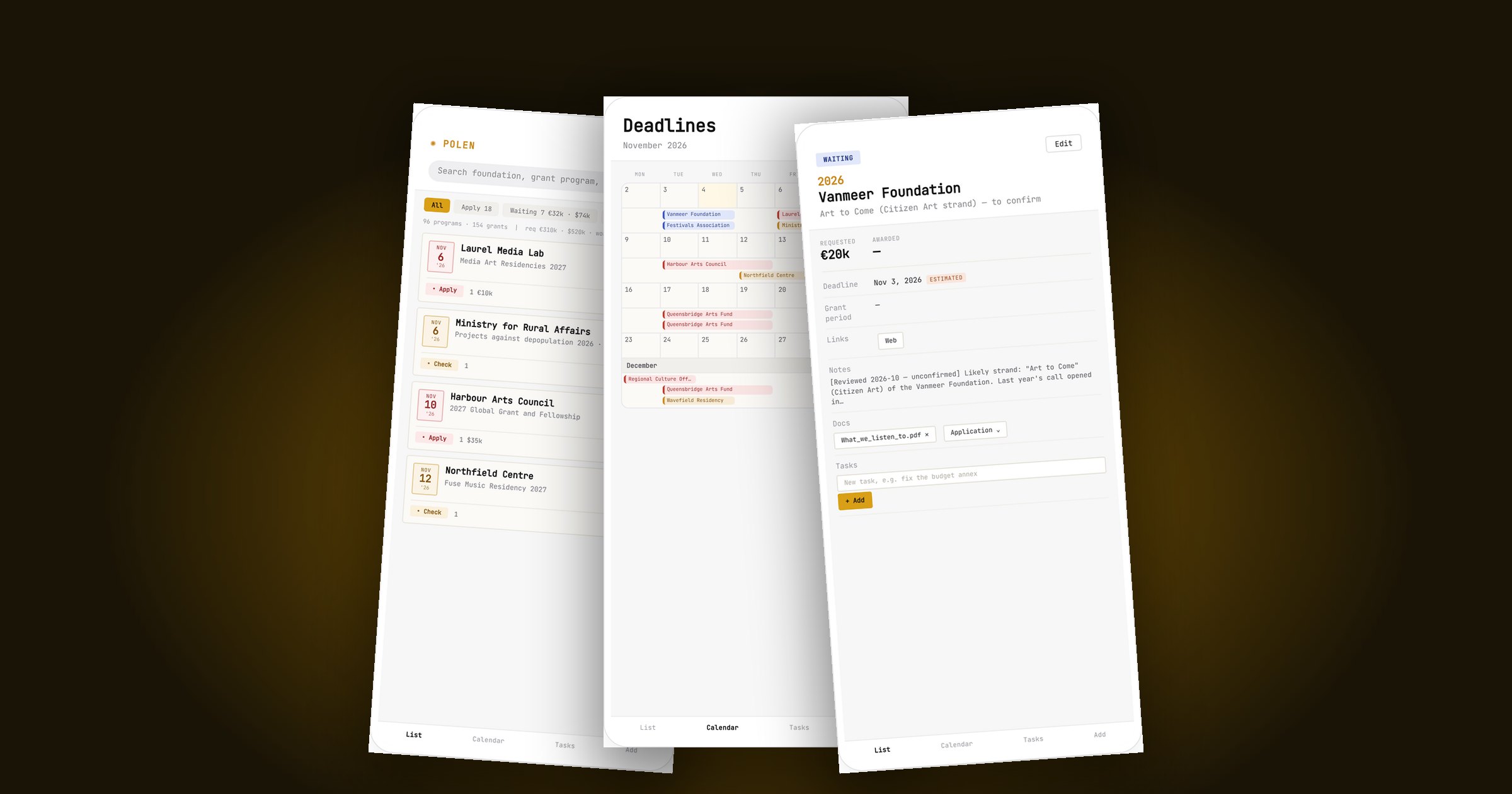
Three screens of Polen: the pipeline list, the deadline calendar and one grant
Role
Design and build, solo
Type
Internal tool, one public form
Platform
Web, phone first
Built with
HTML · Supabase · PostgreSQL
Status
Live, behind a password
01

A calendar problem wearing a filing problem's clothes.

A call opens in May for money that arrives the following spring. The form wants a budget, a letter and three documents written for somebody else eighteen months ago. And the deadline is a date nobody has announced, because last year it was "around the same time".

Spreadsheets handle the list and fail at the dates. Calendars handle the dates and lose the paperwork. The money is in two currencies that must not be added together, and the single most useful fact about any call — is this deadline real or am I guessing — has nowhere to live in either tool.

Half of grant work runs on dates nobody has published. The tool has to be able to say so.

The screens below are drawn, not photographed, and every funder, programme and figure on them is invented. The states, the fields and the two-currency totals are the real ones; which bodies have been asked for how much, and which of them said no, is not a portfolio piece.
02

One list, two ways of reading it.

There is a single collection of grants, and the app is two views onto it plus the things hanging off each one. The fourth door is the unusual one: a form that strangers can post into without ever seeing the rest.

List
  • Filter by state
  • Search funder, programme, notes
  • Running totals per currency
  • Days left on every row
Calendar
  • The same pipeline by month
  • Colour carries the state
  • Clusters visible in advance
One grant
  • Asked and awarded, side by side
  • Deadline, flagged if estimated
  • Documents, each with a type
  • Tasks that belong to it
Suggestion form
  • Public, no account
  • Writes, and cannot read
  • Arrives as pending
  • Accepted or rejected by the owner
03

Set like a ledger, on purpose.

Colour · sampled from the running app
Paper
#F8F8F0
Warm, not white
Gold
#D09000
Primary action
Deep gold
#604810
Type on gold
Apply
#D05858
Deadline is close
Rule
#E0D8C8
Dividers, card edges
Quiet
#686868
Secondary text
Colour is not decoration here: it is the state. Gold is the thing to act on, red means the deadline is near, and the paper is warm rather than white so a screen full of dates does not glare at midnight, which is when this gets used.
Type · monospace, end to end
20px
800
POLEN
12px
700
Laurel Media Lab
11px
500
req €310k · $520k · won €61k
10px
400
Nov 3, 2026 · estimated
Set in JetBrains Mono throughout, which is an odd choice for an interface and the right one here. Every screen is amounts and dates in columns, and a monospace keeps €465k and €48k the same width, so the eye compares them without reading them. Corners are 2–3px: this is paperwork, not an app that wants to be liked.
04

The screens.

✺ POLEN + Add
All Apply 18 Waiting 7 €32k · $74k Awarded 24
96 programs · 154 grants  |  req €310k · $520k · won €61k · $190k
Nov6'26
Laurel Media Lab
Media Art Residencies 2027
• Apply 1 €10k 2d
Nov6'26
Ministry for Rural Affairs
Projects against depopulation 2026 · local bodies
• Check 1 2d
Nov10'26
Harbour Arts Council
2027 Global Grant and Fellowship
• Apply 1 $35k 6d
Nov12'26
Northfield Centre
Fuse Music Residency 2027
• Check 1 8d
Screen 01

Everything, with the clock showing

The list is sorted by what runs out first, not by funder or by size. Days left sit under the date badge, and the state of each row is repeated as a word at the bottom of its card so the colour is never doing the work alone.

  • ATwo totals, never added together: euros and dollars stay apart, because converting them fixes a rate that will be wrong by the time the answer comes.
  • BThe filter chips carry their own counts and sums, so the shape of the pipeline is readable before tapping anything.
  • C"Check" is a state of its own, separate from "Apply": it means the call is not confirmed yet and somebody has to go and look.
Deadlines
November 2026
MonTueWedThu FriSatSun
2
3
4
5
6
7
8
Vanmeer Foundation
Laurel Media Lab
Festivals Association
Ministry for Rural Affairs
9
10
11
12
13
14
15
Harbour Arts Council
Northfield Centre
16
17
18
19
20
21
22
Queensbridge Arts Fund
23
24
25
26
27
28
29
December
Regional Culture Office
Queensbridge Arts Fund
Wavefield Residency
Screen 02

The year as a shape

The same pipeline, drawn as a month. This view exists for one reason: to show a week with four deadlines in it while there is still time to move something, rather than on the morning they all land.

  • ABars span days rather than sitting on one, because a grant has a window, not a moment.
  • BMonths run on without a page break, so the end of a year is not a wall. Grant seasons do not respect January.
  • CSame three state colours as the list. Nothing new to learn when switching views.
Waiting Edit
2026
Vanmeer Foundation
Art to Come (Citizen Art strand) — to confirm
Requested€20k
Awarded—
Deadline Nov 3, 2026 Estimated
Grant period—
LinksWeb
Notes [Reviewed 2026-10 — unconfirmed] Likely strand: "Art to Come" (Citizen Art) of the Vanmeer Foundation. Last year's call opened in…
Docs What_we_listen_to.pdf ✕ Application ⌄
Tasks New task, e.g. fix the budget annex + Add
Screen 03

One call, everything it needs

Asked and awarded sit side by side at the top, because the gap between them is the only number that matters at a glance. Everything below is the paperwork, in the order you reach for it.

  • AAn estimated deadline is labelled estimated. It can be planned around without ever being mistaken for a fact.
  • BNotes keep the reasoning and the date it was last checked, so next year's version of you knows how much to trust it.
  • CDocuments carry a type, and tasks live with the application rather than in a separate list that nobody opens.
05

Four decisions that shaped it.

01

A guess is labelled a guess

Most deadlines are inferred from last year before they are announced. Marking one "estimated" is the smallest possible feature and the one that changed how the tool is used: a guess can go in the list on the day it is made.

02

Two currencies, kept apart

Euros and dollars are totalled separately rather than converted. Any rate chosen today is wrong by the time a decision lands twelve months later, and a wrong total is worse than two right ones.

03

Anyone can suggest a call

A public form takes a foundation, a programme, a deadline and a note, with no account. Colleagues and strangers send in what they spot; it arrives as pending and waits to be accepted or rejected.

04

The database says no, not the page

That open form is safe because row-level security grants the public insert and nothing else. Reading, changing and deleting are restricted to the authenticated owner in Postgres itself, so hiding a button is never the defence.

06

Where it stands.

Polen is in daily use and behind a password. It was built for one organisation's grant work and has not been tested with anyone else, so there are no numbers in this case study and no claim about how much money it has helped raise.

The change it did make is narrow enough to describe honestly: an unconfirmed deadline now has somewhere to live, which means it gets written down in the week somebody thinks of it rather than in the week it expires.

HTMLSupabase PostgreSQLRow-level security
Next case study Vela →